01
Position
Role in the space
Use it as a bright, gentle, and enduring base for the space.
- Large-area background material
- Living Room System Wall
- Full bedroom wardrobe doors
Mountain Brook Oak-2
A warm light oak grain that creates a natural, quiet, and enduring foundation for modern homes.
Fine straight grain and gentle cathedral patterns keep cabinetry, wall panels, and interiors warm and restrained.
Technical and Delivery Information
Substrate
Custom moisture-resistant particleboard / Fine-OSB / Plywood substrate
Thickness
18mm
Size
1220 × 2800mm
Surface
Fine woodgrain press plate / synchronized woodgrain press plate
Edge Banding
Use matching edge banding or warm light woodgrain edge banding
Type
Warm Light Oak Grain
Application
Cabinet Doors / Wall Panels / Floating Base Cabinets
Space
Living Room System Wall / Bedroom Wardrobe / Study Cabinetry / Entry Cabinet
Definition
A warm light oakgrain suited to large background surfaces.
Position
Use it as a bright, gentle, and enduring base for the space.
Texture
Low-contrast woodgrain that remains visually continuous across large areas.
Boundary
Best for a quiet expression; avoid competing with too many strong patterns.
Application
Mountain Brook Oak-2 can extend from living room system walls to cabinetry and doors, creating a natural, bright, and stable base in contemporary homes. It stays away from the visual center and supports other materials as a background.
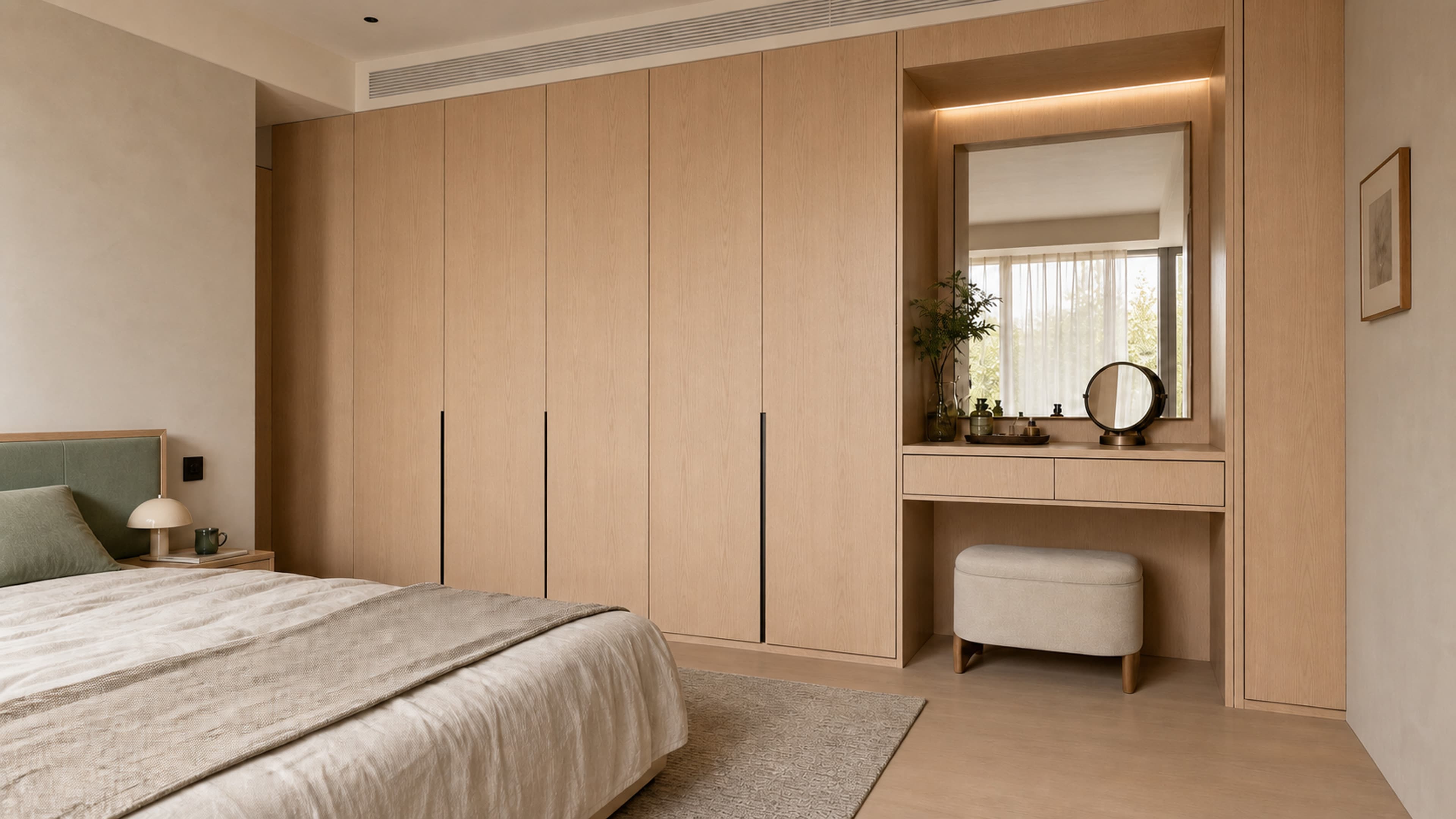
Spatial effect visualization. Confirm actual color and texture with a physical sample.
Suitable as a primary material across large areas
Wall panels, floating base cabinets, and display cabinet frames
Pair with bronze glass or deep coffee open shelves to add depth without losing the overall brightness.
Suitable for a full set of cabinet doors
Hinged doors, sliding doors, and bedside cabinetry
Use matching edge banding to reduce contrast at door gaps and side edges.
Use at a medium-to-high proportion
Bookcases, entry cabinets, and local wall panels
Keeps areas with limited daylight feeling light and prevents cabinetry from appearing heavy.
Light & Proportion
First define the finish's role in the space, then use lighting, background materials, and accents to adjust visual weight.
Content status · Sample review pendingLighting
Mountain Brook Oak-2 works best with even, soft ambient lighting. Warm light can enrich the wood tone, but overly yellow light or uneven illumination can make the light wood lose clarity.
Color temperature
Use 3000–3500K as a reference for the desired spatial atmosphere
Ambient lighting
Use continuous, even ambient lighting so full-height cabinet doors and wall panels retain a consistent tonal relationship.
Accent lighting
Use concealed linear lighting in open shelves, keeping the light strip away from the panel surface to prevent bright hotspots.
On-site confirmation
Before ordering, review the physical sample in daylight and under the project lighting to confirm the wood tone, edge banding, and door-gap relationship.
Proportion
Warm light woodgrain works well as a large background surface. Rather than dividing materials evenly, establish a continuous Mountain Brook Oak-2 surface first, then control the rhythm with neutral tones and dark details.
Primary Material
50–70%
Continuous background surfaces across cabinet doors, wall panels, and system cabinetry
Supporting material
15–25%
Warm sand, textile texture, or a low-contrast wall surface
Accent material
5–10%
Deep coffee open shelves, bronze glass, and fine linear trims
These are design guidance values for proposal discussions, not fixed ratios. Adjust them according to elevation dimensions, lighting conditions, and physical samples.
Scene Gallery
See how the finish changes across continuous surfaces and local details through different spatial structures, cabinetry roles, camera views, and lighting conditions.
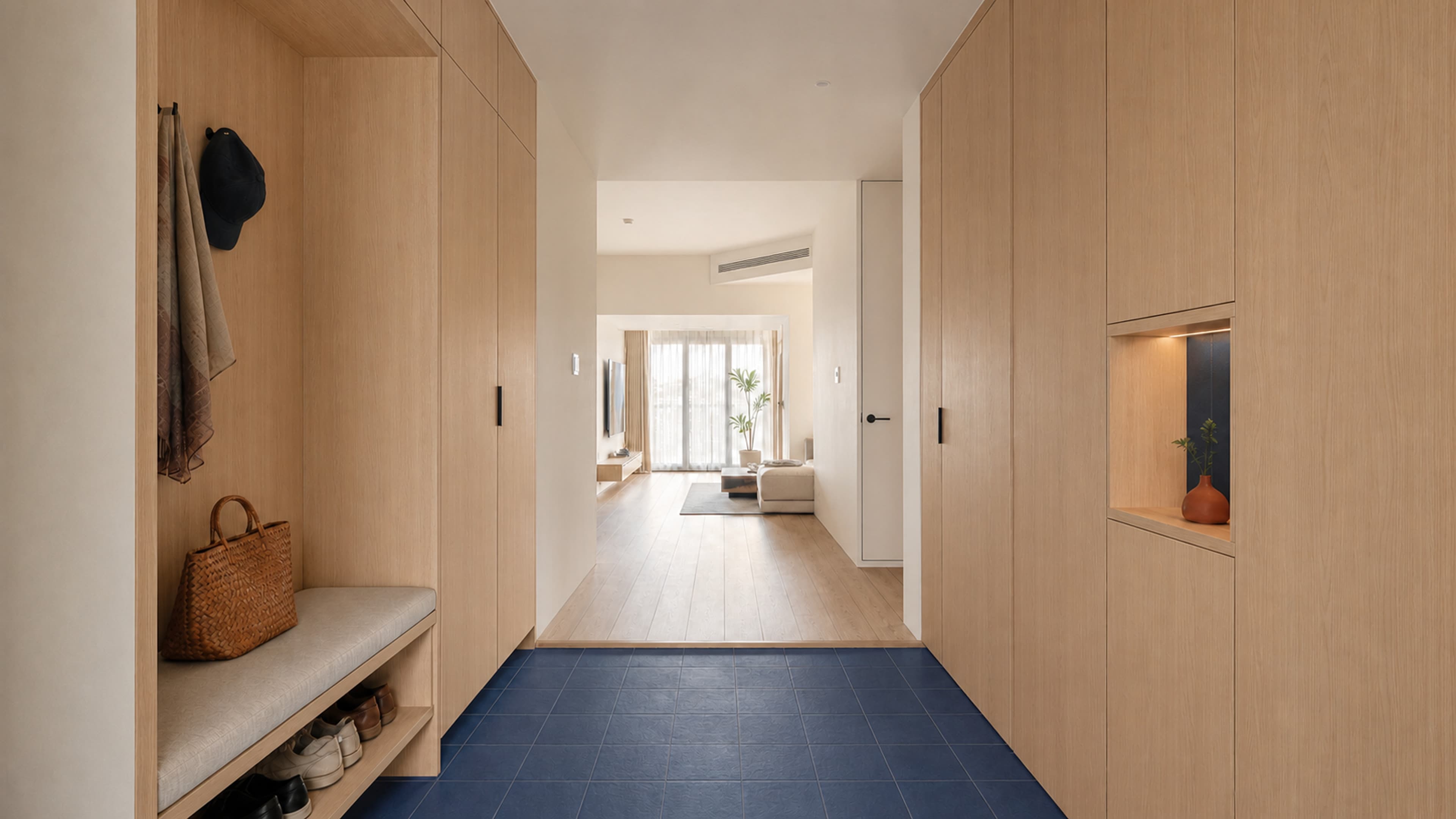
Entry收纳
Spatial visualization双侧Warm Light Woodgrain柜体承担入户收纳, 蓝灰地面与少量Warm摆件建立清晰边界.
AI-generated spatial visualization. Confirm actual color, texture, and workmanship with physical samples.
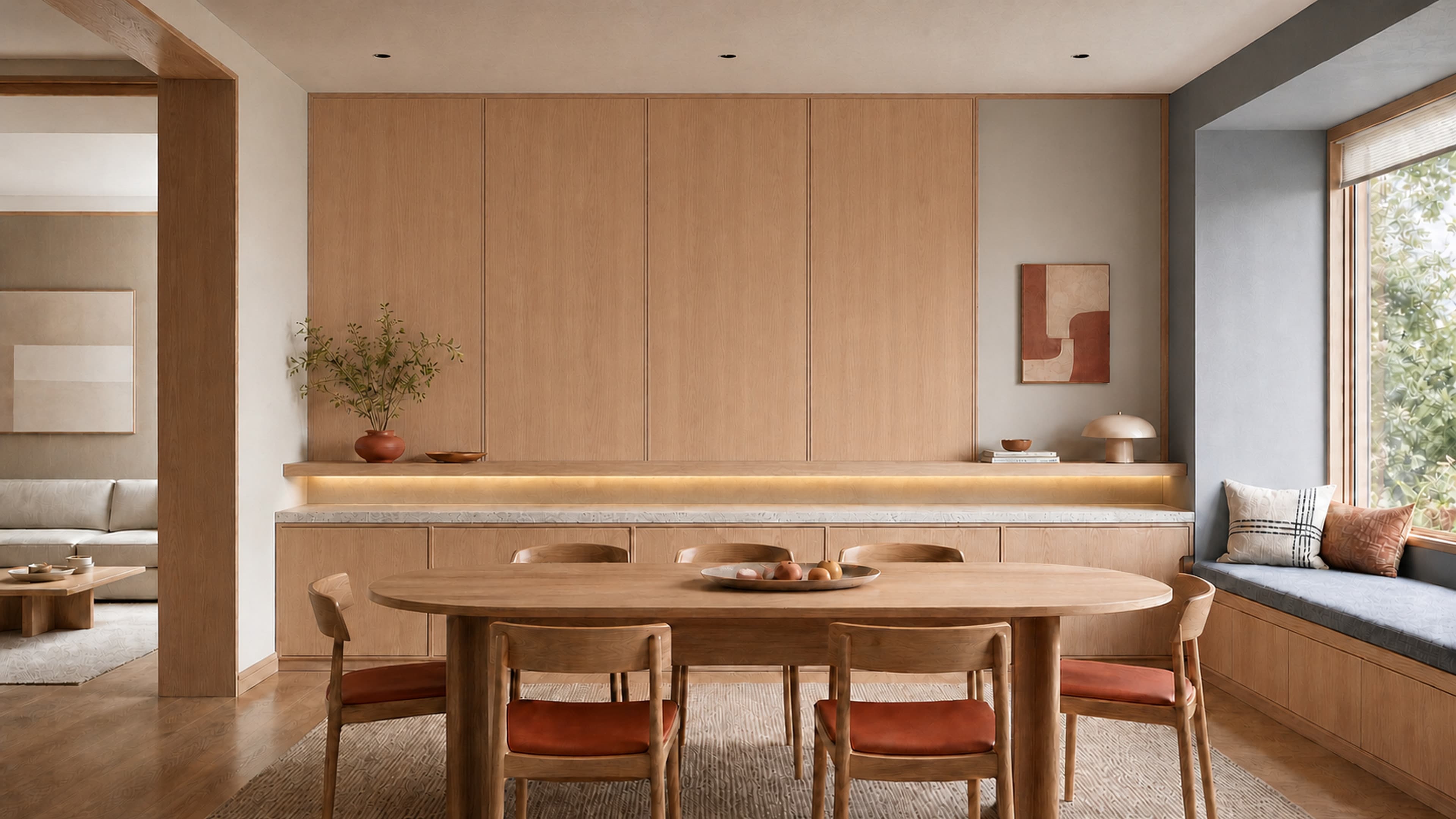
家庭Dining Room
Spatial visualizationWarm Light Woodgrain建立连续餐叙背景, 蓝灰与陶土色只在卡座, 座椅和饰品中少量出现.
AI-generated spatial visualization. Confirm actual color, texture, and workmanship with physical samples.
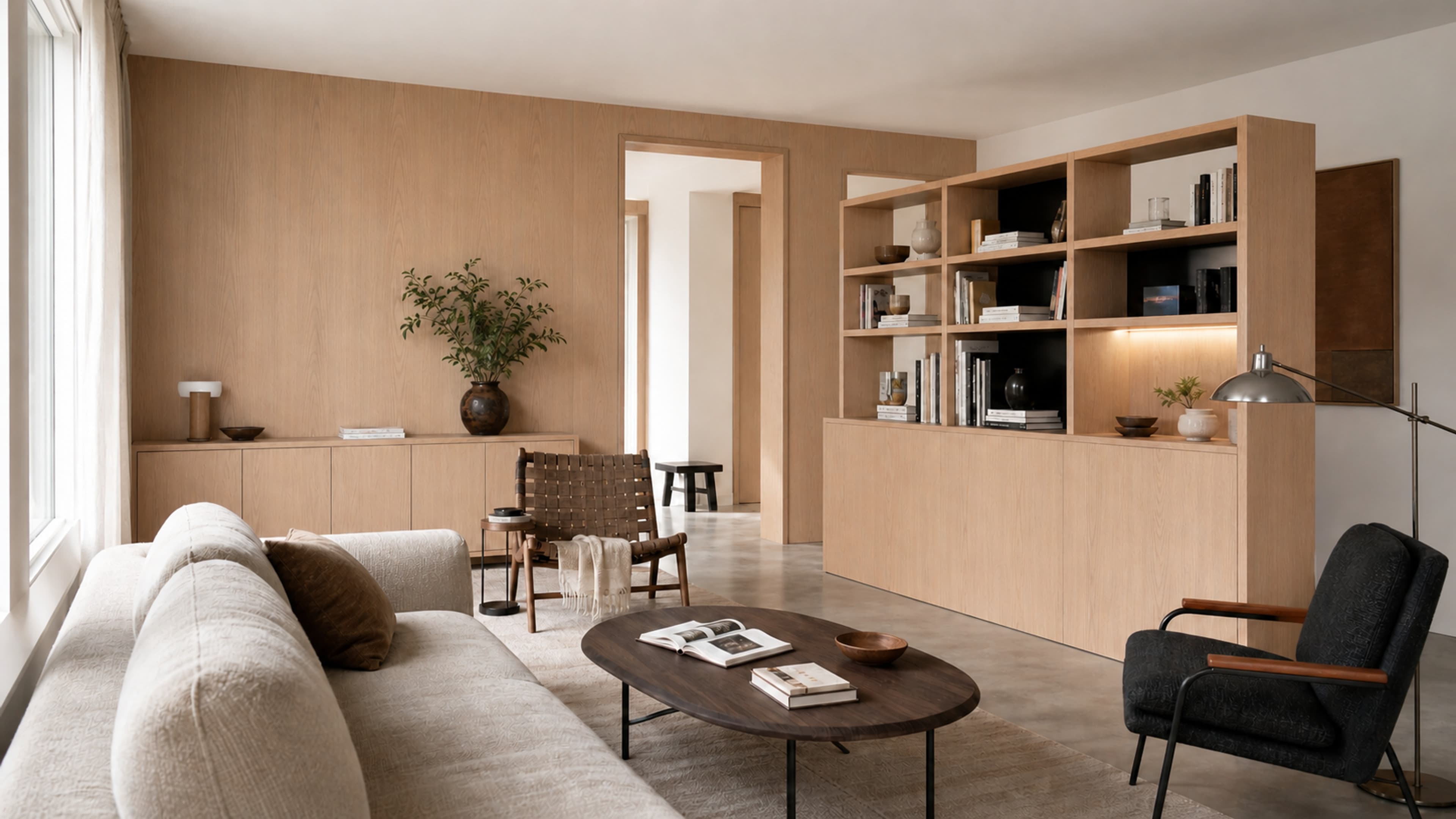
客厅与阅读区
Spatial visualizationWarm Light Woodgrain用于Wall Panels, 低柜和书柜, 深咖与黑色细节控制在家具和局部背板中.
AI-generated spatial visualization. Confirm actual color, texture, and workmanship with physical samples.
Palette
Use low-saturation materials to build spatial relationships.
Warm Sand
Use on walls, cabinet interiors, or as a background to reduce repetition when light woodgrain covers a large area.
Linen Texture
Use on wardrobe doors or flush doors to soften bedrooms and integrated door-wall surfaces.
Bronze Glass
Use on local display cabinetry or shelf doors to add depth and visual openness.
Dark Coffee Trim
Use for thin trims, open shelves, or interior linings to strengthen structural order.
Delivery
Confirm samples, edge-banding direction, and site trims in advance to reduce color and detail discrepancies in the finished project.
01
Use matching or warm light woodgrain edge banding so door fronts and side edges remain consistent.
02
For continuous use in one space, confirm panel direction and grain alignment in advance.
03
For integrated door-wall systems or large wall panels, retain the project batch and sample-confirmation records.
FAQ
Answers to common early-stage questions about quantity, edge banding, pairing, and order confirmation.
Yes. Its low-contrast grain and warm light base make it suitable as the primary material for living room system walls, full wardrobes, and study cabinetry.
Yes, as a gentle background surface. Confirm door gaps, trim lines, and edge-banding color in advance to avoid contrasting side edges.
Prioritize matching or warm light woodgrain edge banding. If the project needs stronger structure, use a small amount of deep coffee trim.
Yes. Screens affect judgments of woodgrain contrast, color temperature, and surface feel. Confirm the material under site lighting.