breviSurface System

Sakura Grey Crystal Stone

Sakura Grey Crystal Stone

Grey-white fragmented crystal stone pattern creates a stable, enduring surface foundation for contemporary spaces.

Sakura Grey Crystal Stone is a matte stone-pattern finish defined by grey-white fragmented-crystal forms. Light warm-grey areas interweave irregularly with dark-brown and charcoal-black flake-like patterns, keeping the light surface bright while giving it distinct depth. It is best used as a focal surface behind sideboards, on entryway door surrounds, on floating drawer fronts, or on selected TV wall areas, with smoky dark wood tones, warm grey, and bronze glass controlling the overall rhythm.

Technical and Delivery Information

Substrate

  • Custom moisture-resistant, low-odor LSB
  • FOSB (oriented strand board)
  • Custom Fine Surface plywood
  • BS 1088 marine plywood
  • Imported VECO particleboard

Surface

Matte (confirmed by the user; other product specifications await formal documentation)

Edge Banding

  • Matching ABS-G edge banding · 1.0 × 22 mm
  • Matching ABS-G edge banding · 0.8 × 60 mm
  • Matching ABS-G soft-forming edge banding · 0.6 × 60 mm
  • Matching laser edge banding · Multiple sizes available

Environmental grade

ENF grade

Environmental information

Test documentation can be provided for project requirements. Refer to the corresponding report for its scope.

Existing substrate, surface, format, and thickness combinations are available. See the supply specifications below for substrate-specific formats and thicknesses.

View supply specifications for this finishView environmental and edge-banding information

Type

Grey-white fragmented crystal stone pattern

Application

Local Wall Panels / Doorway surrounds and adjoining corner surfaces / Entryway focal backdrop panel

Space

Dining room sideboard / Entryway corner / Entryway focal feature viewed straight on / Living room TV and storage wall

Selection & Evidence

Selection and supporting information: from finish to panel specification

Application and substrate

Choose the substrate, panel format, and thickness for the intended application, and use physical samples to confirm the surface, edge banding, fabrication, and installation requirements.

Specifications and test evidence

Existing substrate, surface, format, and thickness combinations are available. See the supply specifications below for substrate-specific formats and thicknesses.

View substrates and standard stock specifications

Test reports apply only to the samples, specifications, test items, and conditions stated in each report. After selecting the substrate and supply specifications, confirm the corresponding report with brevi before using it to support material selection for this project.

View test reports and their scope

Physical samples and order confirmation

Compare physical samples under the project lighting to check color, grain direction, sheen, feel, and edge banding. Provide the finish name, intended application, panel size and thickness, estimated quantity, and project location so the available samples, documentation, and delivery arrangements can be confirmed.

Environmental Information

Environmental grade and supporting information

Environmental grade
ENF grade

All finished decorative panels in the range are ENF grade. Test documentation can be provided for project requirements. Each test report applies to the samples, specifications, test items, and conditions stated in that report.

View test reports and their scope
Matching Edge Banding

Matching edge banding

Dimensions are thickness × width, in mm.

  • Matching ABS-G edge banding · 1.0 × 22 mm
  • Matching ABS-G edge banding · 0.8 × 60 mm
  • Matching ABS-G soft-forming edge banding · 0.6 × 60 mm
  • Matching laser edge banding · Multiple sizes available

Use physical samples to confirm the color, sheen, and fabrication compatibility of the edge banding and panel surface.

Supply specifications for this finish

The following is the supply range. Regularly stocked specifications do not indicate real-time stock; custom specifications are arranged by order. Confirm available quantity, custom conditions, and dispatch timing before ordering.

Custom moisture-resistant, low-odor LSB

Format
1220 × 2440 / 1220 × 2800 mm
Stocked thickness
9 / 12 / 18 / 22 / 25 mm
Supply details
All listed formats and thicknesses

FOSB (oriented strand board)

Format
1220 × 2440 / 1220 × 2800 mm
Stocked thickness
9 / 18 / 25 mm
Supply details
Other thicknesses by order

Custom Fine Surface plywood

Format
1220 × 2440 / 1220 × 2800 mm
Stocked thickness
2440: 9 / 12 / 18 / 25 mm; 2800: 9 / 12 / 18 mm
Supply details
Other thicknesses by order

BS 1088 marine plywood

Format
1220 × 2440 mm only
Stocked thickness
9 / 18 mm
Supply details
12 / 25 mm by order

Imported VECO particleboard

Format
1220 × 2800 mm only
Stocked thickness
9 / 12 / 18 / 22 / 25 mm
Supply details
All five are regularly stocked specifications

Definition

Finish positioning and texture assessment

Grey-white fragmented-crystal forms interweave with dark flake-like patterns, suited to a restrained yet distinctive focal material in selected areas.

01

Position

Role in the space

Use as a clear local focal point, with dark wood and warm grey providing a supporting backdrop.

  • Sideboard backdrop
  • Entryway doorway surround and drop-zone drawers
  • A selected section of the TV wall
02

Texture

Texture characteristics

Large, non-directional fragmented-crystal forms with dark flake-like patterns interspersed through a grey-white base.

  • Light warm grey base
  • Fragmented crystal-like areas
  • Matte surface
03

Boundary

Application boundaries

Limit the area of continuous use so that the pattern, lighting, and several decorative materials do not compete for attention.

  • One principal surface
  • Avoid covering every surface throughout the home
  • Confirm with a physical sample

Main Scene · Dining Room View

Let the fragmented-crystal stone pattern become a bright focal area within a dark-wood sideboard setting.

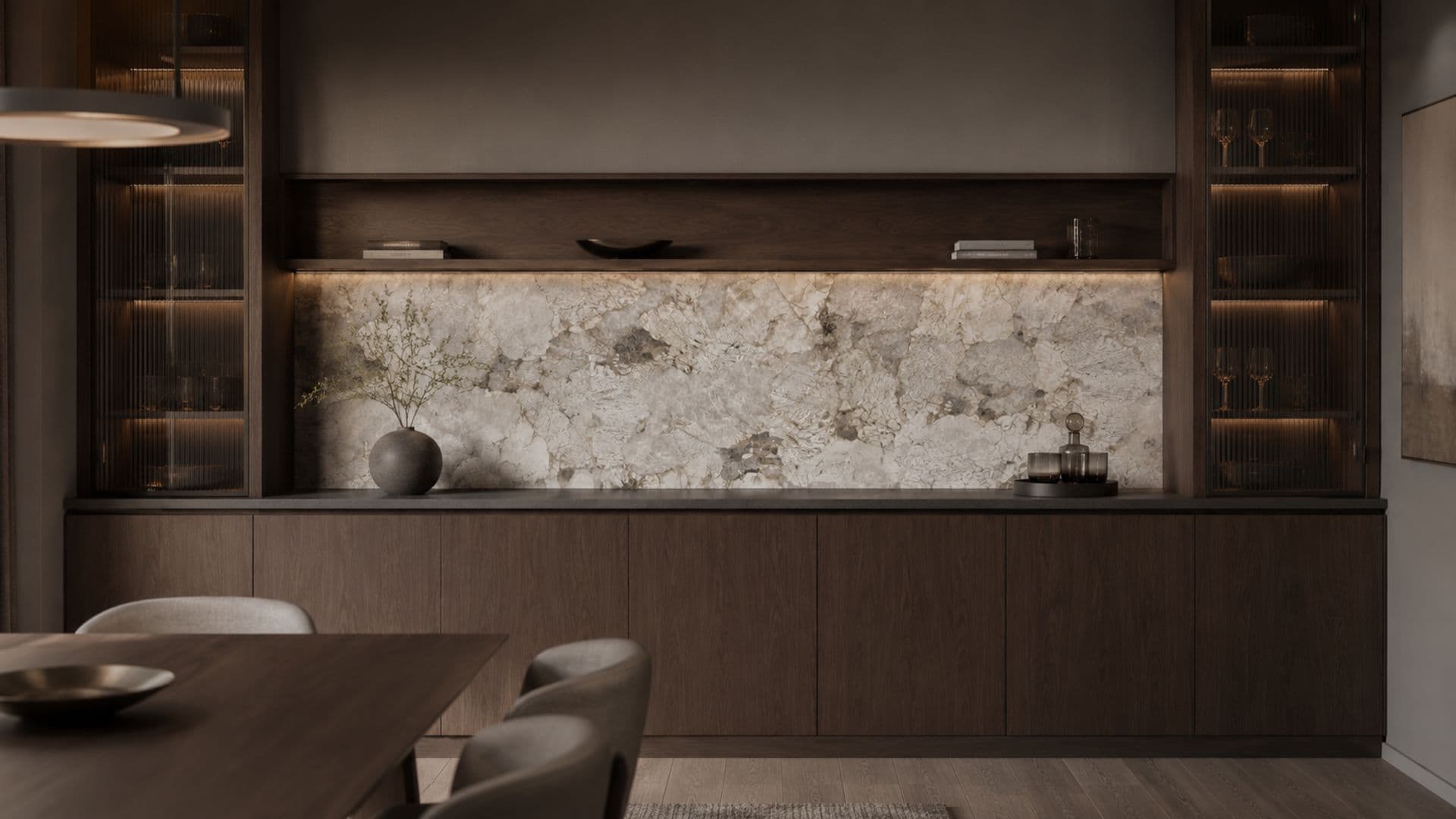
The main visual concentrates Sakura Grey Crystal Stone on the horizontal surface behind the sideboard. Smoky dark-wood cabinetry, warm-grey walls and floors, and bronze glass balance the density of the pattern. The stone pattern forms a single continuous focal area and does not extend onto tabletops, floors, or other cabinet doors.

Sakura Grey Crystal Stone spatial application reference; confirm actual color and texture with a physical sample

Spatial visualization. Confirm actual color, texture, and workmanship with a physical sample.

Stone pattern covers approximately 20–28% of the visible fixed surfaces

Dining room sideboard

Continuous wall panels behind the sideboard and the principal surface between bronze-glass display cabinets on both sides

Use smoked dark wood as the main background and concentrate the stone pattern on one horizontal area. Do not repeat the same strong pattern on the dining table, countertop, and lower cabinets.

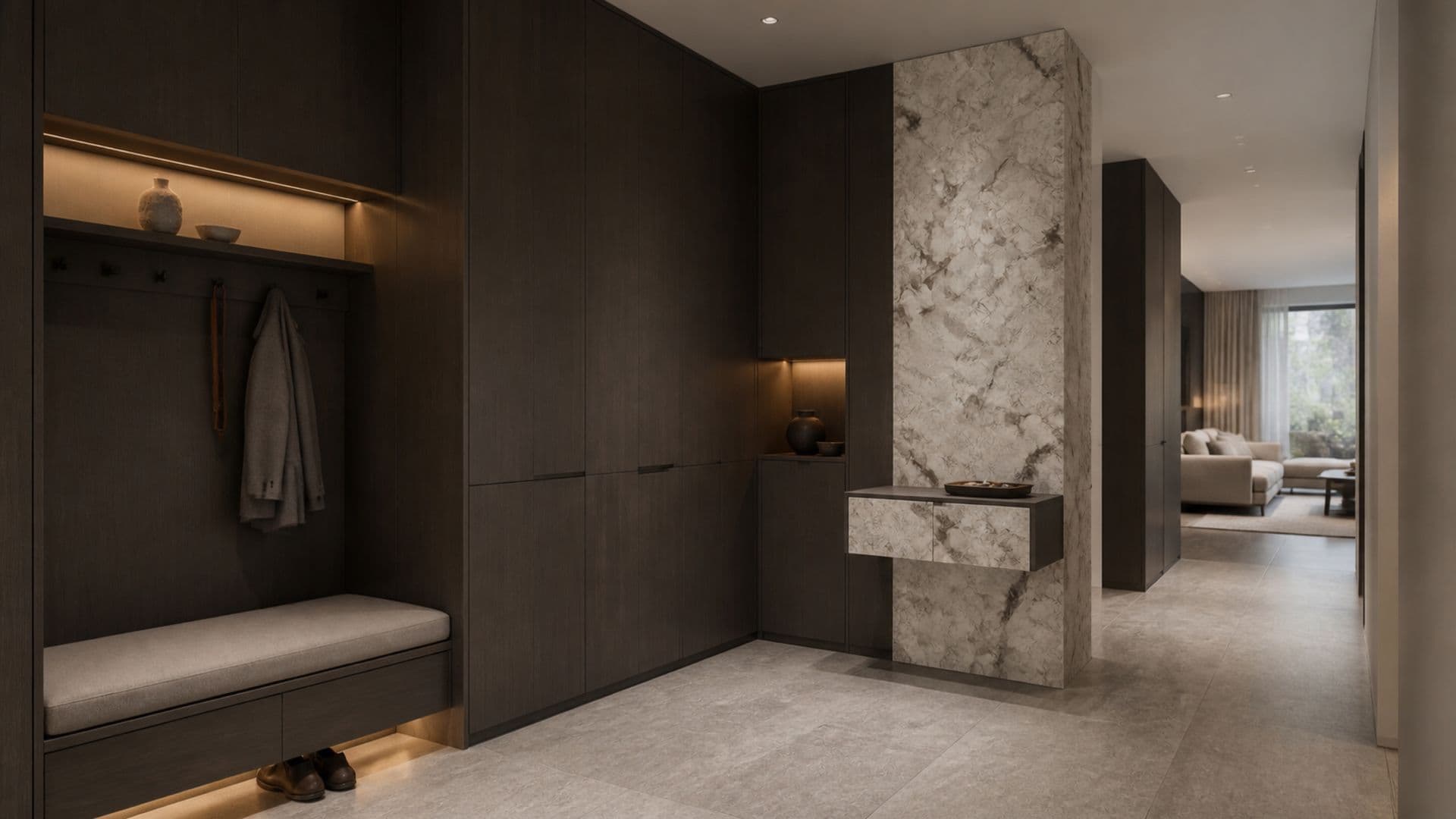
Stone pattern covers approximately 16–22% of the visible fixed surfaces

Entryway corner

Tall panels wrapping around the doorway surround and the fronts of floating drop-zone drawers

Use the stone pattern to mark the turn from the entryway into the living room. Keep shoe and coat storage and the shoe-changing area as continuous dark-wood surfaces so the entrance does not feel fragmented.

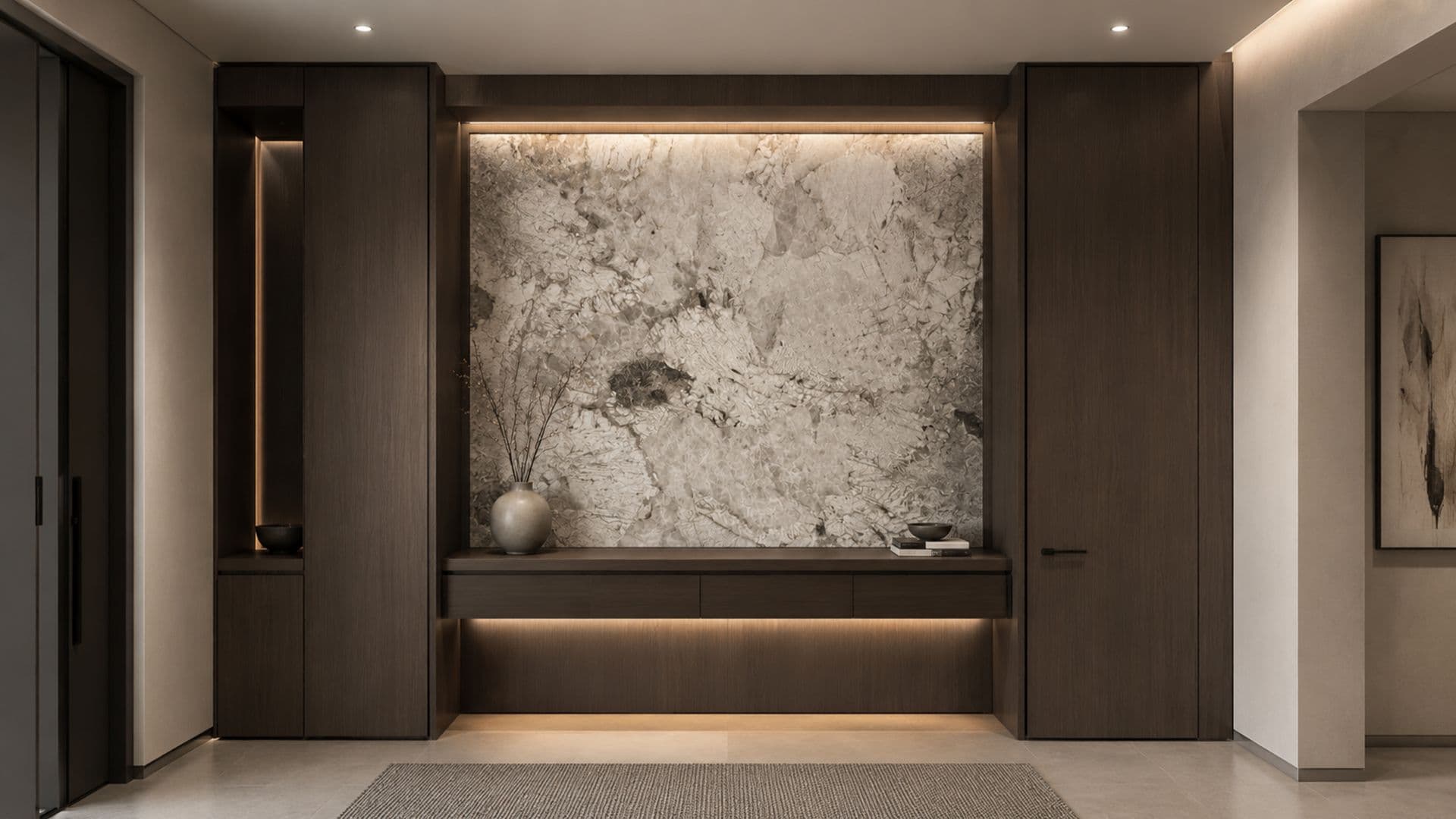
Stone pattern covers approximately 22–30% of the visible fixed surfaces

Entryway focal feature viewed straight on

Central focal backdrop panel, floating storage drawers, and full-height storage on both sides

For the focal feature viewed straight on, use a central stone-pattern panel for distinction, with symmetrical full-height dark-wood cabinets on both sides to organize storage. Limit lighting to surface grazing and indirect illumination below the cabinets.

Stone pattern covers approximately 20–28% of the visible fixed surfaces

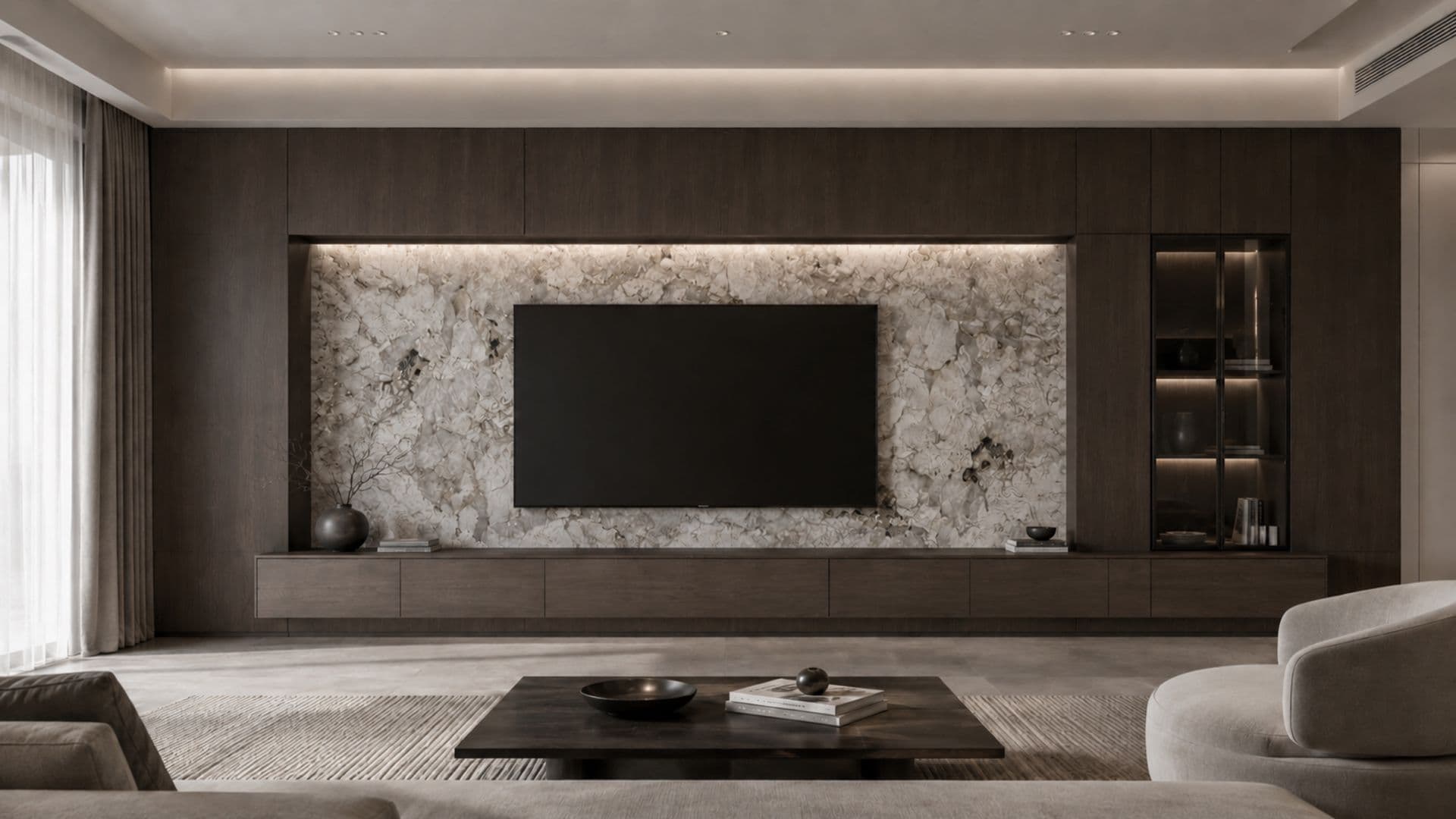
Living room TV and storage wall

A single recessed wall panel behind the TV and a continuous dark-wood low cabinet

Keep a single focal area behind the TV, with dark wood cabinetry and warm-grey flooring providing quiet space around it. Do not repeat the stone pattern on the low cabinet, side walls, or adjacent doors.

Light & Proportion

Lighting and Material Proportions

First define the finish's role in the space, then use lighting, background materials, and accents to adjust visual weight.

Lighting

Use soft, diffuse light to reveal the edges of the crystal-like fragments without making the matte surface appear glossy.

The distinctive appearance of Sakura Grey Crystal Stone comes from its grey-white areas and dark fragments, without relying on glossy reflections. Establish even ambient lighting first, then add depth with low-intensity wall washing set away from the panel surface.

Color temperature

Begin by comparing an overall color temperature of 3000–3500K, and also assess the finish in natural light

Ambient lighting

Use continuous, soft ambient lighting to maintain a stable relationship between the grey-white base, warm grey walls, and dark wood.

Accent lighting

Keep local linear lights away from the panel surface and reduce their brightness to avoid distinct mirror-like highlights, glowing edges, or a backlit translucent appearance.

On-site confirmation

Before ordering, view a physical sample in natural light, under the project ambient lighting, and with local lights switched on to confirm the grey-white base, dark pattern, and matte surface.

Proportion

Let dark wood provide the quiet background, with the stone pattern serving as a single focal point.

This fragmented crystal pattern has a high level of visual detail. Start by selecting one principal stone-pattern surface, then use smoked dark wood and warm grey for broad, steady backgrounds. Use bronze glass, charcoal black, and warm-toned metal only for small accents and boundaries.

Sakura Grey Crystal Stone

16–30%

A sideboard backdrop, entryway corner panel, entryway focal feature, or single TV backdrop surface

Smoked dark wood and dark grey

45–55%

Cabinet walls, low cabinets, door surrounds, and the main storage volumes

Warm grey and restrained details

22–34%

Walls, floors, textiles, and small amounts of bronze glass, charcoal black, or warm-toned metal

These are suggested visual proportions for proposal discussions, not fixed project quantities. Keep bronze glass, charcoal black, and warm-toned metal to approximately 5% or less in total.

Scene Gallery

More Spatial Applications

See how the finish changes across continuous surfaces and local details through different spatial structures, cabinetry roles, camera views, and lighting conditions.

Sakura Grey Crystal Stone: Option 2 · Entryway application reference

Option 2 · Entryway

Spatial visualization

Tall door-surround panels at the corner, floating drop-zone drawers, and dark-wood shoe and coat storage

The stone pattern is concentrated at the turn in the entryway, while the dark-wood cabinetry forms a continuous storage background. Natural light at the far end gives the entrance a greater sense of depth.

Spatial visualization. Confirm actual color, texture, and workmanship with a physical sample.

Sakura Grey Crystal Stone: Option 3 · Living Room application reference

Option 3 · Living Room

Spatial visualization

A single stone-pattern backdrop behind the TV, a long low cabinet, and bronze-glass display shelves to the side

The stone pattern is confined to one continuous surface behind the TV. Full-wall dark-wood cabinetry, low cabinets, and warm-grey soft furnishings occupy the remaining visual area.

Spatial visualization. Confirm actual color, texture, and workmanship with a physical sample.

Sakura Grey Crystal Stone: Option 4 · Entryway Focal Wall application reference

Option 4 · Entryway Focal Wall

Spatial visualization

A central entryway feature panel, floating storage drawers, and full-height storage on both sides

A symmetrical front view confines the fragmented-crystal stone pattern to the central focal surface, while dark-wood cabinetry on both sides and warm-grey flooring form quiet boundaries.

Spatial visualization. Confirm actual color, texture, and workmanship with a physical sample.

Palette

Recommended Pairings

Use low-saturation materials to build spatial relationships.

Smoked Dark Wood

Smoked dark wood

Use on cabinetry and wall surfaces, low cabinets, and doorway surrounds to provide broad, quiet backgrounds that balance the visual detail of the fragmented crystal pattern.

Warm Grey

Warm grey

Use on walls, floors, and textiles to create a soft transition between the grey-white stone pattern and dark wood tones.

Tea Glass

Bronze Glass

Suitable for display-cabinet doors or narrow recesses, using transparency and darkness to add depth. Do not give it the same visual proportion as the stone pattern.

Charcoal Detail

Fine charcoal-black and warm-toned metal lines

Use for the TV, frames, handles, or trims, keeping their combined proportion low and using them only to define boundaries.

Delivery

Installation and delivery notes

Confirm samples, edge-banding direction, and site trims in advance to reduce color and detail discrepancies in the finished project.

01

The page content is based on the original scan confirmed by the user and four spatial visualizations. Use a physical sample to confirm the actual color, pattern scale, and matte tactile feel.

02

Before using the finish continuously across a large area, check the layout against door gaps, panel divisions, and the positions of dark patterns to avoid mechanical repetition across adjacent surfaces.

03

The available information does not establish the substrate, specifications, edge banding, environmental grade, or in-use performance. Refer to formal product documentation and project samples.

FAQ

FAQ

Answers to common early-stage questions about quantity, edge banding, pairing, and order confirmation.

Is Sakura Grey Crystal Stone suitable for an entire surface?+

It can be used continuously on one clearly defined principal surface, but repeated full coverage across multiple types of surface in the same space is not recommended. Begin proposal comparisons at approximately 16–30% of the visible fixed surfaces, leaving a quiet background of dark wood tones and warm grey.

What lighting suits this finish?+

Begin by comparing soft ambient lighting at 3000–3500K, and also review the finish in natural light. Keep local wall-washing lights away from the panel surface to avoid distinct highlights or glowing edges on the matte finish.

Which materials pair well with Sakura Grey Crystal Stone?+

Prioritize smoky dark wood tones, warm-grey walls and floors, and small amounts of bronze glass, then finish the edges with fine charcoal-black or warm-metal lines. Avoid adding another highly contrasting, strongly patterned primary material.

Does the crystalline appearance in the image mean the panel transmits light?+

No. The crystalline appearance describes only the visual depth of the finish. This page does not present it as a claim of light transmission, backlighting capability, or natural-stone performance.

What should be confirmed before ordering?+

View physical samples in natural light and under the actual project lighting, and confirm panel divisions, pattern scale, edge banding, substrate, specifications, and formal product documentation. Visualizations cannot replace physical-sample and technical confirmation.